
Could We Be Any Hotter?

The Human Body and its Ability to Adapt to Rising Heat
Imagine living in a penthouse on the 50th floor of a high-rise building. You like keeping your home at a comfortable 20°C throughout the year, regardless of the weather outside.
During the bitterly cold winter months, you turn on the heating to keep the interior warm, but as summer arrives and temperatures soar, you switch on the air conditioning to cool things down. Either way, your intended goal remains the same: consistently maintaining a comfortable temperature inside your home.

But have you ever noticed that on days when temperatures drop below zero or soar to extreme highs, your heating or cooling system has to work much harder to maintain that temperature? It may take longer to reach your desired temperature, consume more energy and struggle to keep up when outdoor conditions become particularly extreme.
That is, in many ways, how the human body works.
Just like your home, your body constantly works to maintain a stable internal temperature, even as the environment around it changes. This is part of a process called homeostasis — the body’s ability to maintain a relatively stable internal environment despite external fluctuations.
One of the most important components of this process is thermoregulation, the biological system responsible for controlling body temperature. Think of it as your body’s own heating and cooling system. Through mechanisms such as sweating, changes in blood circulation and heat exchange with the environment, your body works to keep its core temperature around 37°C.

But what happens when the body’s internal cooling system has to work harder, more frequently and for longer periods? What happens when the environment outside becomes increasingly difficult to cope with?
As our planet warms and extreme heat becomes an increasingly significant public-health concern, these questions are no longer just about the temperature of the house you live in, but also about the temperature of your eternal home: your body.
The human body is remarkably good at maintaining its internal temperature. At the centre of this process is a small yet important structure in the brain called the hypothalamus. Often described as the body’s thermostat, it continuously receives information about body temperature and coordinates responses to either release excess heat or conserve and generate it.

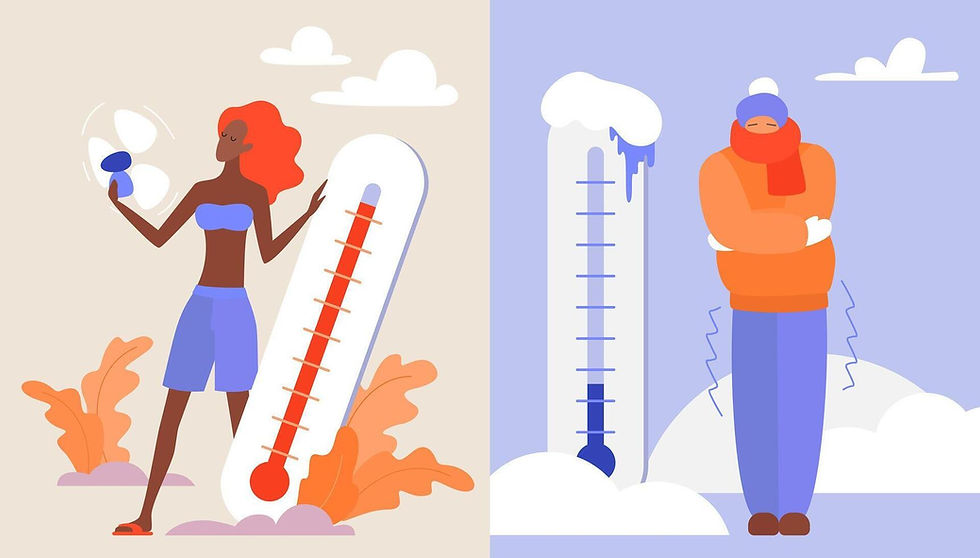
When your body begins to overheat, several mechanisms come into play. Blood vessels near the surface of the skin widen, a process known as vasodilation, allowing more warm blood to flow towards the skin and facilitating heat exchange with the environment. At the same time, sweat glands become more active. As sweat evaporates from the skin, it carries heat away from the body, helping to cool you down.
When temperatures drop, the body takes the opposite approach, constricting the blood vessels near the skin and reducing heat loss to the environment. Muscles may begin to contract involuntarily, producing the shivering response. These contractions generate additional heat, helping the body maintain its core temperature.

Together, these mechanisms allow the human body to respond to changing environmental conditions and maintain a relatively stable internal temperature. While these mechanisms are remarkably effective, prolonged heat exposure can place considerable physiological demands on the body. The heart has to work harder to maintain circulation, fluids and electrolytes are lost through sweating, and the body must continuously balance heat regulation with the demands of its other vital functions.
With repeated exposure to hot conditions, the body begins to undergo physiological changes that allow it to cope with heat more effectively. This process is known as heat acclimatisation. Although the human body is not a passive victim of its environment, there is an important distinction between becoming accustomed to heat through repeated exposure and evolving to withstand it. An individual’s body can begin adapting within days, with further changes developing over subsequent weeks, whereas evolutionary adaptations occur across generations. At the pace at which our planet is warming, waiting for evolutionary adaptation to catch up may not be our best bet.
If evolution cannot keep pace with the changing climate, perhaps we need to look at what the human body can do within its own lifetime. Interestingly, the ability to tolerate heat is not entirely fixed. Through controlled and repeated exposure to hot conditions, we can train our bodies to gradually become more efficient at regulating their temperature.
One of the most accessible ways to encourage these adaptations is through regular physical activity. Activities such as running, cycling, brisk walking and swimming increase the body’s metabolic activity, causing muscles to generate heat and core temperature to rise. In response, the body activates its cooling mechanisms, including sweating and increased blood flow to the skin. With repeated exercise, particularly in warmer conditions, the body gradually becomes more efficient at dissipating heat. Over time, this can lead to an earlier onset of sweating, an expansion of plasma volume and reduced cardiovascular strain during comparable heat exposure.
Another interesting approach is sauna bathing. Unlike exercise, which generates heat internally through muscular activity, sauna bathing exposes the body to external heat. This stimulates sweating, increases blood flow to the skin and places additional demands on the cardiovascular system. With repeated sessions, some adaptations may overlap with those observed during heat acclimatisation. Although research into sauna-induced heat adaptation is still developing, it offers an interesting example of how the body can respond to repeated, controlled heat exposure.

However, individual adaptation should never be mistaken for a solution to rising global temperatures. While we can take steps to improve our heat tolerance and protect ourselves, we cannot expect our bodies to compensate indefinitely for a warming planet. Just like in the penthouse on the 50th floor, maintaining a comfortable internal environment requires more than simply asking the system to work harder. It requires changing the conditions around it.
From greener cities and cooler buildings to stronger climate action, protecting our bodies ultimately means protecting the world we call home. After all, our bodies are our eternal homes, and they deserve a planet that allows them to thrive.


