
Starving the Wild: How Disease and Deforestation Pushed Tigers to Our Doorsteps
- Ashley Chung

- Jan 14
- 2 min read
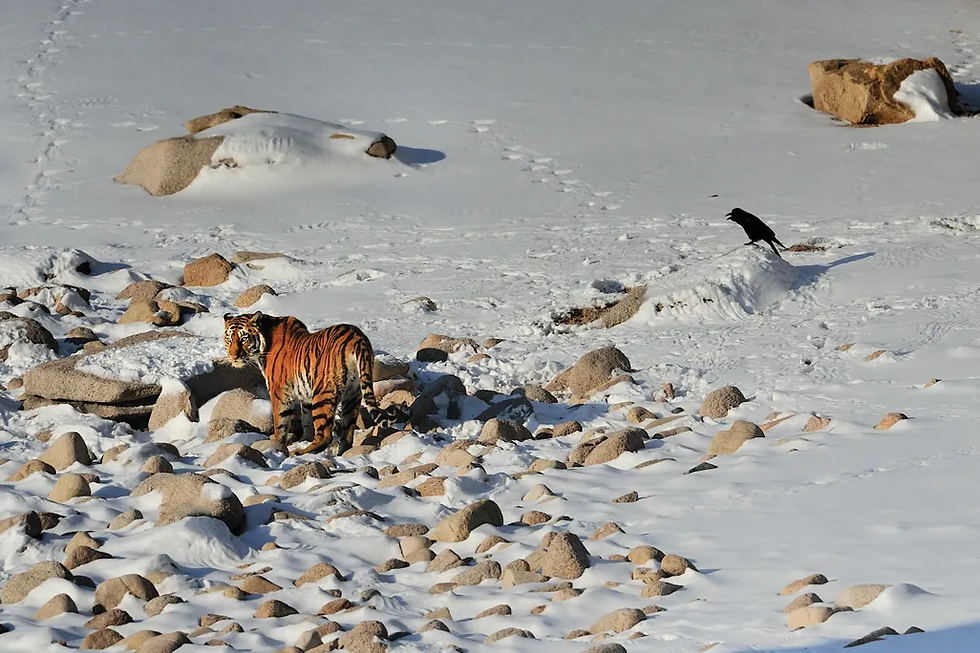
For a long time, the Amur tiger was rare in the far east of Russia. It was almost invisible as it hid deep in the forest. But recently, that has changed. Tigers have begun appearing closer to villages, and the reason behind it is not aggression. It is hunger.
Over the past few years, villagers started noticing tigers at night. At first, they took dogs from the edges of towns. Then they attacked livestock like horses and cattle. Eventually, people were hurt and killed. This past winter became the deadliest for tiger attacks in the region in decades. These attacks were unexpected, but they did not happen without cause.
One of the reasons is African swine fever, a deadly disease that affects pigs and wild boar. The virus kills nearly every animal it infects. It has a fatality rate between 90-100%. In eastern Russia, a large number of wild boars were killed, which is one of the Amur tiger’s most important food sources, especially for female tigers to feed their cubs. When this food disappeared, the tigers were left with few options. They did not suddenly become violent. Instead, they were pushed into survival mode.
Experts who studied captured tigers found that many were severely underweight, dehydrated, or injured, and even some had gunshot wounds.
African swine fever likely spread into Russia from China after a major outbreak there in 2018 that killed millions of pigs. The damage was made worse by illegal hunting of deer and increased logging in tiger habitats. Together, these factors created what scientists describe as a “perfect storm,” where tigers lost both their food and their home.
Talking openly about tiger conservation in Russia can be dangerous. The issue is politically sensitive, and some experts choose to stay anonymous. Still, many agree on the fact that the problem isn’t necessarily about tigers, but it is because of the damaged ecosystem the tigers are stuck in.
This situation shows how fragile the balance between humans and nature can be. When forests are destroyed, prey animals disappear, and diseases spread, even the strongest species can be put in danger. This forces them, such as tigers, to invade the human environment.
Individuals should advocate to protect both tigers and humans, and avoid viewing them as counteracts. The best solution is to restore healthy forests and manage the widespread diseases. When prey returns and habitats recover to normal, tigers naturally move back into the wild.
Works Cited
“African Swine Fever.” AGES, https://www.ages.at/en/mensch/krankheit/krankheitserreger-von-a-bis-z/african-swine-fever#:~:text=Death%20occurs%20within%206%2D13%20days%20(up%20to,is%2090%2D100%25%20in%20domestic%20and%20wild%20pigs. Accessed 7 Jan 2026.
Cheng, Jieming. “Risk factors for the spread of African Swine Fever in China: A systematic review of Chinese‐language literature.” PubMed Central, 2022. National Library of Medicine, https://pmc.ncbi.nlm.nih.gov/articles/PMC9790558/. Accessed 7 Jan 2025.


